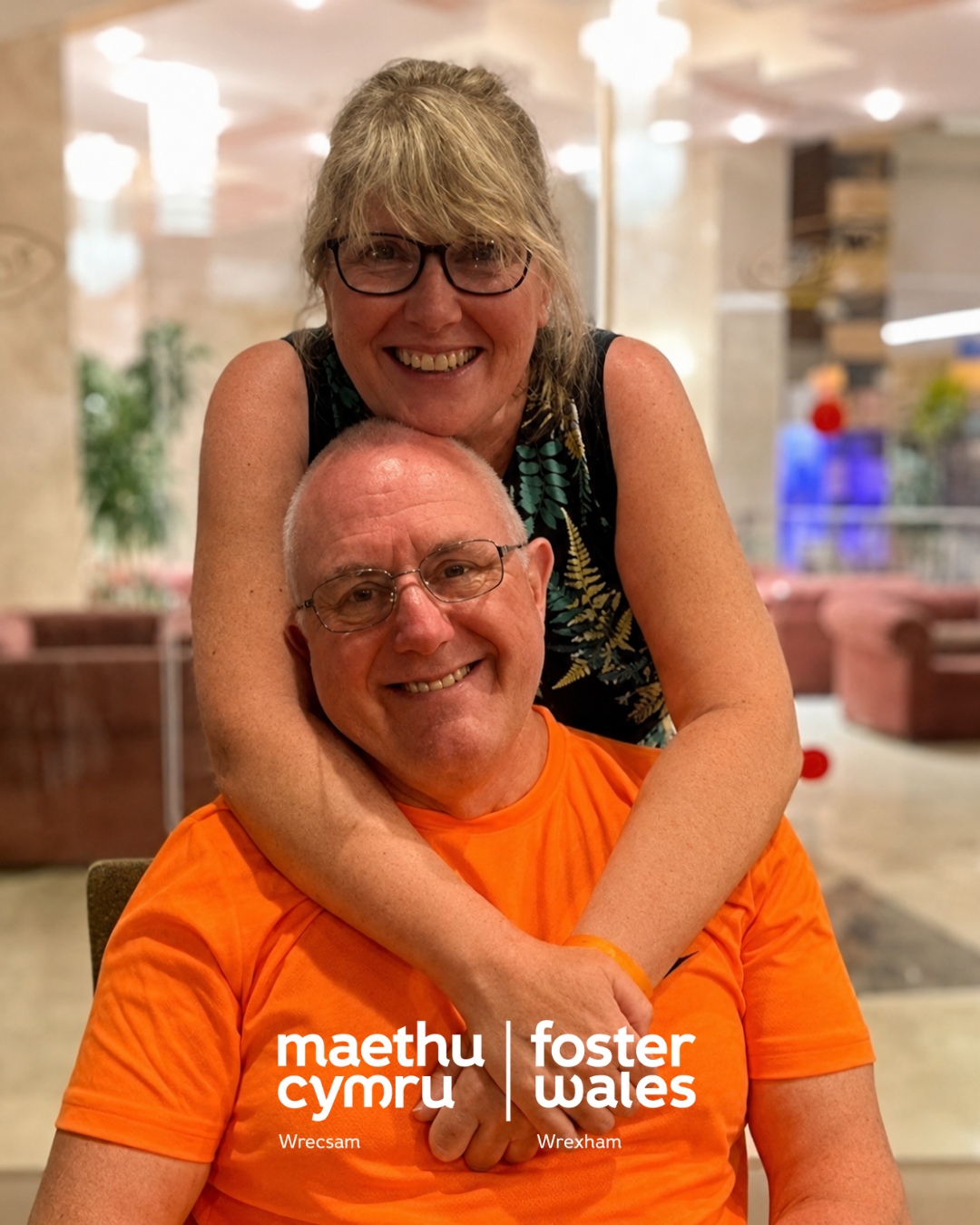
Cath and Neil have been fostering with Foster Wales Wrexham since 2018. Over the years they’ve cared for children in all sorts of situations, but short-term fostering is where much of their experience lies. Here, they talk about what it really involves, and why it matters more than people realise.
wanting to make a difference
Cath and Neil first thought seriously about fostering back in 2012. Cath was already working with children in her role as a primary school teacher, and the couple also ran a drop-in session for teenagers at their local church. It was through those sessions that the idea really took hold.
“I remember there was one young lady who used to come along,” Neil says. “She was quite angry and upset at first. Then she went to live with a foster carer, and after a couple of months, you could see the transformation in her. It made us think – wow, you really can make a difference.”
“We’d both been thinking about it separately,” Cath adds. “And then one night we had a proper conversation, and it went from there.”
They have three children of their own and began fostering through an independent agency before transferring to Foster Wales Wrexham in 2018. Since then, they’ve cared for children in all kinds of situations. Right now, two girls are living with them: one has been with them long-term, and a younger girl who is currently with them on a short-term basis while her longer-term plan is worked out. Alongside that, they also provide respite for other foster carers who need a break and have welcomed children into their home at very short notice when needed.
Short-term fostering is what makes up the biggest part of their experience, and it’s the type they find people understand the least.
Short-term fostering can last anywhere from a few months to a few years. What makes it different from long-term fostering isn’t necessarily the length of time, but the plan: most children who are fostered short-term are working towards something – returning home to their parents, moving in with relatives, or in some cases, moving on to adoption. The role of a short-term foster carer is to provide a safe, stable home while that longer-term plan takes shape.
what short-term fostering looks like day-to-day
Ask Cath and Neil what a typical day looks like and they’ll tell you: it looks like any other family’s day. School runs. Packed lunches. Homework. Bedtime routines. Tea on the table.
“Children need normality,” Cath says. “Especially children who haven’t had much of it. The routine matters. Knowing that dinner will be at the same time, that you’ll be picked up from school, that someone will come and say goodnight – those things are huge.”
But short-term fostering also asks something more of carers. Children who are fostered short-term are often living with uncertainty: decisions are being made about their futures, sometimes in courts, sometimes in family meetings, sometimes across multiple professionals. They can’t always understand what’s happening or why, and Cath and Neil’s job is to help them feel safe in the middle of all of that.
That might mean attending contact sessions where children spend time with their parents. It might mean helping a child prepare for a big change, talking through what their next home might be like, or simply being steady and calm when a child is anxious or upset. “You’re not just providing a bed for the night,” Neil says. “You’re helping them process something that’s really hard.”
holding things steady
Children who come to Cath and Neil often arrive unsettled. Some are confused. Some are angry. Some are very quiet. Most of them, the couple say, just need someone to hold things steady while the bigger decisions are being made around them.
“You can’t always fix what’s happened to them,” Cath says. “But you can make sure that while they’re with you, they feel safe. That they’re listened to. That they matter.”
They work closely with their supervising social worker and with each child’s own social worker throughout. Transitions, whether a child is moving back to family, to a new carer, or to adopters, are planned carefully, and Cath and Neil are part of that process. They’ll meet new carers or adoptive parents alongside the child, help the child feel comfortable with them, and stay involved until everyone is confident the move is going well.
“It’s never just: here today, gone tomorrow,” Neil says. “Every transition is handled with care. The children are at the centre of it, always.”
what about saying goodbye?
It’s the question almost everyone asks. “Doesn’t it break your heart when they have to go back?”
“It’s emotional, yes. You care about these children. Of course you do,” Cath says. “But when a child moves on to somewhere safe, back to family, to people who love them, to a permanent home, that’s not a loss. That’s the whole point. That’s what we’re working towards.”
“If everyone who considered fostering but decided they couldn’t foster because of how hard it is to say goodbye – who would do it?” Neil says. “These children need foster carers. They need people who will love them enough to find it hard. Yes, it’s emotional. But it’s also immensely rewarding.”
And it doesn’t have to mean losing touch. Cath and Neil stay in contact with the children they’ve cared for, if they’d like them to. Some do. An occasional message, a photo, a note to say how things are going. “Knowing they’re okay,” Cath says, “that means everything.”
“If a child leaves our home feeling more secure than when they arrived, more confident, more settled – then we’ve done our job.”
the support that makes it possible
Cath and Neil are clear that they don’t do this alone. Their supervising social worker is a regular presence, checking in, talking through any challenges, making sure they have what they need.
“The local authority are always there for you,” Cath says. “They go above and beyond to support both the children in their care and the foster carers who look after them.”
There’s also the community of other Foster Wales Wrexham carers – people who understand what the role involves in a way that’s hard to explain to friends or family. Coffee mornings, social events, shared experiences. “You’re not on your own with it,” Neil says. “There’s always someone at the end of the phone, day or night.” You can find out more about the support available to foster carers in Wrexham on our website.
what cath and neil would say to anyone thinking about it
Cath and Neil aren’t surprised that people are drawn to long-term fostering first, it feels more straightforward, they say, more like the image people have in their minds. But they’d encourage anyone to think seriously about the short-term route.
“You don’t need to have all the answers,” Cath says. “You don’t need a perfect house or a perfect life. You need to be able to offer a child safety and stability and someone who’s genuinely in their corner. Even a few months of that can change the course of a child’s life.”
“They won’t always remember everything about their time here,” Neil says. “But they’ll remember feeling safe. They’ll carry that with them. And that’s worth everything.”
If Cath and Neil’s story has made you think fostering might be for you, we’d love to hear from you. Find out more about who can foster and how the process works on our website, or read more stories from foster carers in Wrexham. When you’re ready, get in touch with our team, we’re here to help.